
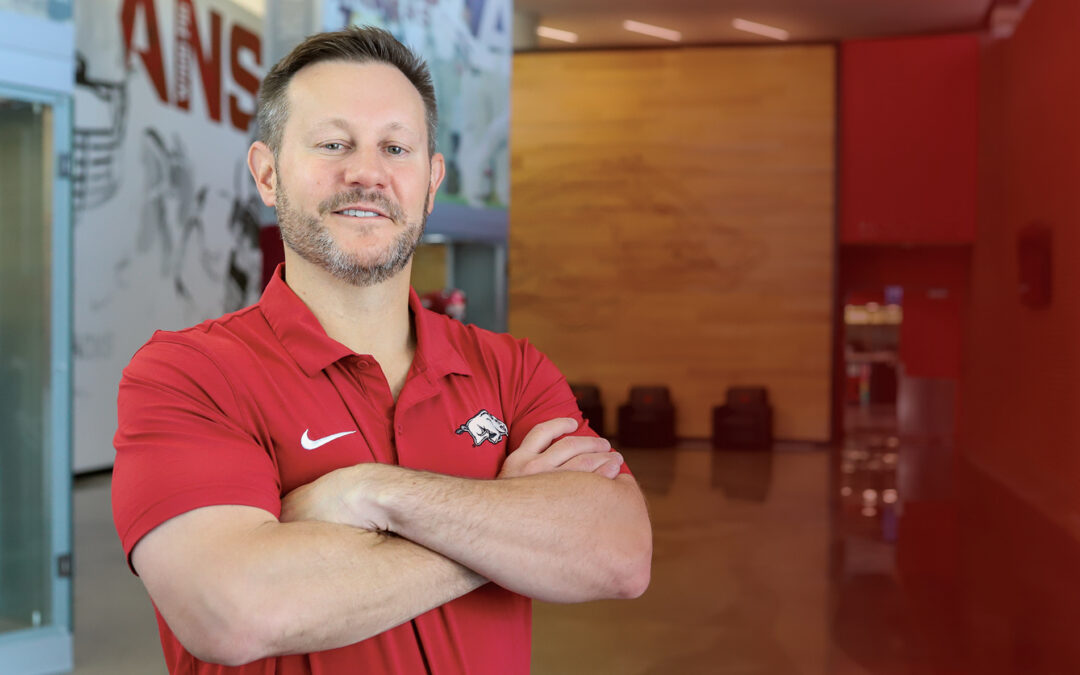
The list began with lightbulbs.
Not stats. Not championships. Not the Southeastern Conference. Light bulbs.
Fresh paint. New weights in the weight room. A shorter walk to lunch. Different music in the fourth quarter — none of those changes will decide whether Arkansas wins football games this fall. But Ryan Silverfield talks about them with the same conviction he brings to discussions of recruiting, player development, or program longevity.
When Celebrate Arkansas caught up with the Razorbacks’ new head coach early this summer, his holistic approach became clear as he laid out the numbers behind something most people would never think to calculate: the distance his players walk each day simply getting their meals. From their parking lot to the Jerry & Gene Jones Family Student-Athlete Success Center and back adds more than a mile and a half to their day after three meals. That figure doesn’t seem like a big deal for a collegiate athlete, until Silverfield points out that while Arkansas players trek roughly 206 additional miles over the course of a year just staying fed, other programs shuttle players even short distances to preserve their legs. Silverfield saw that Arkansas had an opportunity to think differently about the details surrounding its athletes every day because, no matter how small, every detail reinforces the standard. “Everything’s important and everything matters,” he says simply.
It’s a mindset that surfaces again and again. Ask about recruiting, and he ties it to accountability. Ask about player development, and he returns to accountability. Ask about building a winning football program, and the answer isn’t a single recruiting class or a new offensive scheme. It’s to make sure everyone — from the head coach to the backup long snapper, the nutrition staff to admissions, the janitor to the sports information director — “has true buy-in, and feels responsible for the success of the program,” he asserts. “It’s not just the coaches. It’s not just the players.”
His philosophy of shared ownership arrives in Fayetteville at a moment when expectations couldn’t be higher.
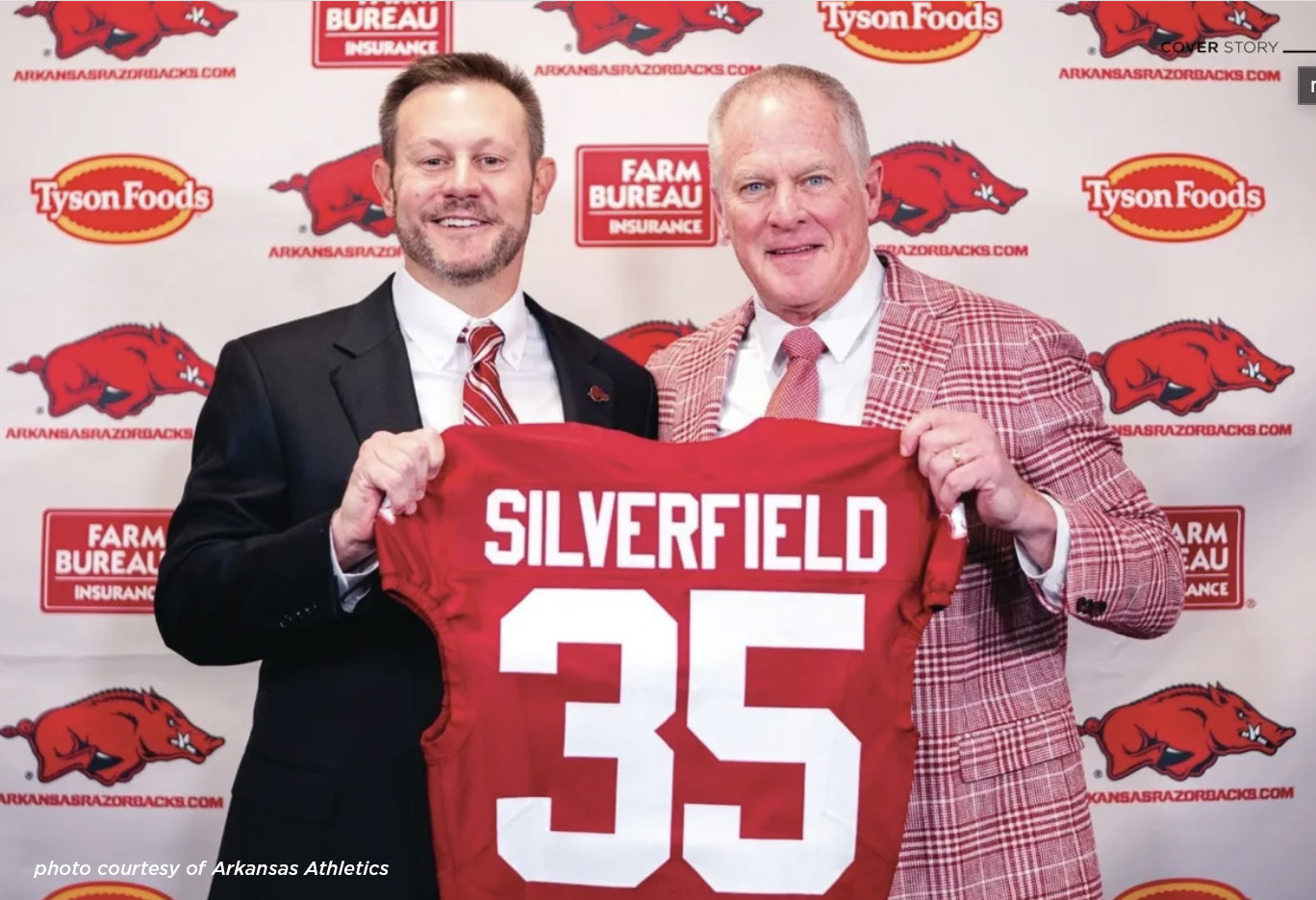
Silverfield takes over his first SEC program as Arkansas’ 35th head football coach following three consecutive heartbreaking seasons for the Hogs, and amid the constantly evolving landscape of college football itself through developments like the transfer portal, NIL, revenue sharing, conference realignment, and beyond. The Razorbacks are betting on the coach who helped make Memphis one of the nation’s top programs in wins over the last three seasons. Silverfield’s decade on the other side of the Mississippi includes the last six years as UofM head coach where he guided the Tigers to 50 wins, six bowl appearances, and the program’s fifth and sixth-ever 10-win seasons in back-to-back years, with teams that each averaged more than 30 points per game.
“I learned so much in Memphis. But whether you’re at a G6 or a Power Four program, it’s still always about the relationships with the players and how you do things and how you go about your business,” says Coach Silverfield, also drawing on a career spanning high school, NFL, and collegiate ball across different conferences. During his time there, Memphis not only became a perennial winner on the field, but also expanded facilities, boosted academic performance among players, raised graduation rates, and established the kind of year-over-year consistency many programs spend decades chasing.
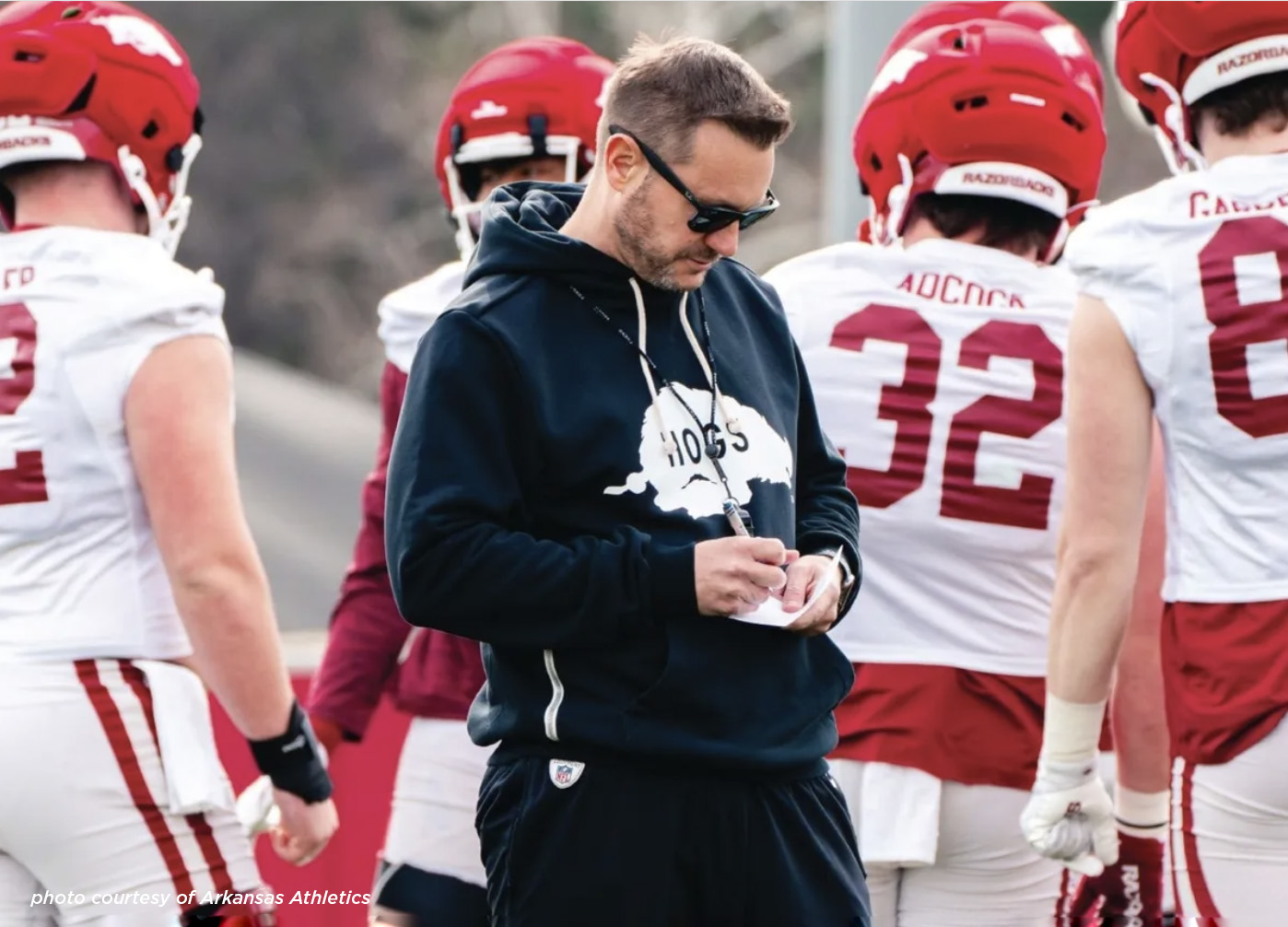
None of it happened by accident. The developments grew from a shared commitment to bettering every part of the program — every decision strengthening the next one until progress becomes the standard instead of the exception. It’s the kind of systemic change he aims to recreate at Arkansas. “The plan is to be here for a long time, and to do that, you’ve got to stabilize the program.”
That process began almost immediately. Rather than arriving with assumptions, Silverfield started asking questions. He met individually with returning players, donors, and people within the athletic department and challenged them to be honest about what needed to improve. He wasn’t looking for complaints or finger-pointing, he explains, but for honest feedback about what had been missing. Some answers centered on the physical environment — brighter facilities, updated equipment, the kinds of changes that reflect pride in the place people come to work every day. Others talked about the game-day atmosphere. “If I’ve had an 18-year-old who just got here as a freshman, and a 70-year-old donor both saying let’s quit playing ‘Cotton Eye Joe’ going into the fourth quarter, we should be listening to that,” he posits. Some of those comments have already spurred a major sound system upgrade in the stadium, enhanced lighting, updated music choices, and other investments in the fan experience.
What Silverfield didn’t expect was how many of those players were asking for the same thing already at the heart of his coaching: accountability. They wanted a program where showing up on time matters. Where giving your all in practice matters. Where going to class matters. Where expectations are clear so that the guys are better supported in holding themselves — and each other — to a consistent standard every day. “That’s unique because you’d think not many players would say that, but they want that. They said that was something that had been lacking,” he shares. “That’s our job as a staff to get that done day-to-day. That’s how you build a culture.”
“It became clear during our conversations that Coach Silverfield shares our vision of making the College Football Playoffs and competing for a national championship,” Vice Chancellor and Director of Athletics Hunter Yurachek said at the time of his hiring. “With our new and significant financial investment in the football program, we are confident we now have the coach and resources to make that happen. Throughout the search process, Coach Silverfield’s proven ability to win games over a sustained period separated him from the pack and made him the right choice to be our next head football coach. His teams at Memphis have been consistent winners since he took over the program in 2019. The knowledge of our state and region he brings along with the ability to build and maintain a program will provide a great foundation for our program moving forward.”
Yurachek’s confidence aligns with the way Silverfield describes building a roster. He isn’t searching for players looking for
the easiest path or the quickest payoff. He wants competitors who understand exactly what they’re signing up for. When recruits sit down across from him, Coach doesn’t promise shortcuts or instant success. He tells them the opposite. “You come here, it’s going to be really hard. Coming to Arkansas takes more sacrifice than anywhere else.” He admits that candor has earned him some raised eyebrows, but he’s not worried about scaring recruits away. “I want someone who, when it gets really hard, or it’s in the middle of training camp, or we’re down a couple points in the game, says, ‘This is what we worked for!’ Those are the type of people you can go into the foxhole with. The ones who flinch at ‘we’re going to work harder here than anywhere else’ — nah, I don’t want those people. I want them to go play for our opponents,” he adds with a grin.
It’s striking how often accountability becomes the answer. To Silverfield, the word doesn’t represent punishment or control; it’s an agreement everyone makes with one another. It means showing up prepared, honoring commitments, embracing difficult conversations, and trusting that everyone inside the building is chasing the same standard. “Some days it’s a lot of X’s and O’s and a lot of schemes, but I don’t want the guys to ever lose sight of the things that make them better people. Because if we can help them be the best versions of themselves, we’re going to have better success in between the white lines.” That’s the shift he hopes will become quickly visible to Razorback Nation when the Hogs take the field, where fans recognize a team operating with a different level of purpose. “As a head coach, you continue to get spread thinner, but you can never lose sight of why I ultimately got into this profession, which is to win football games and develop young men.”
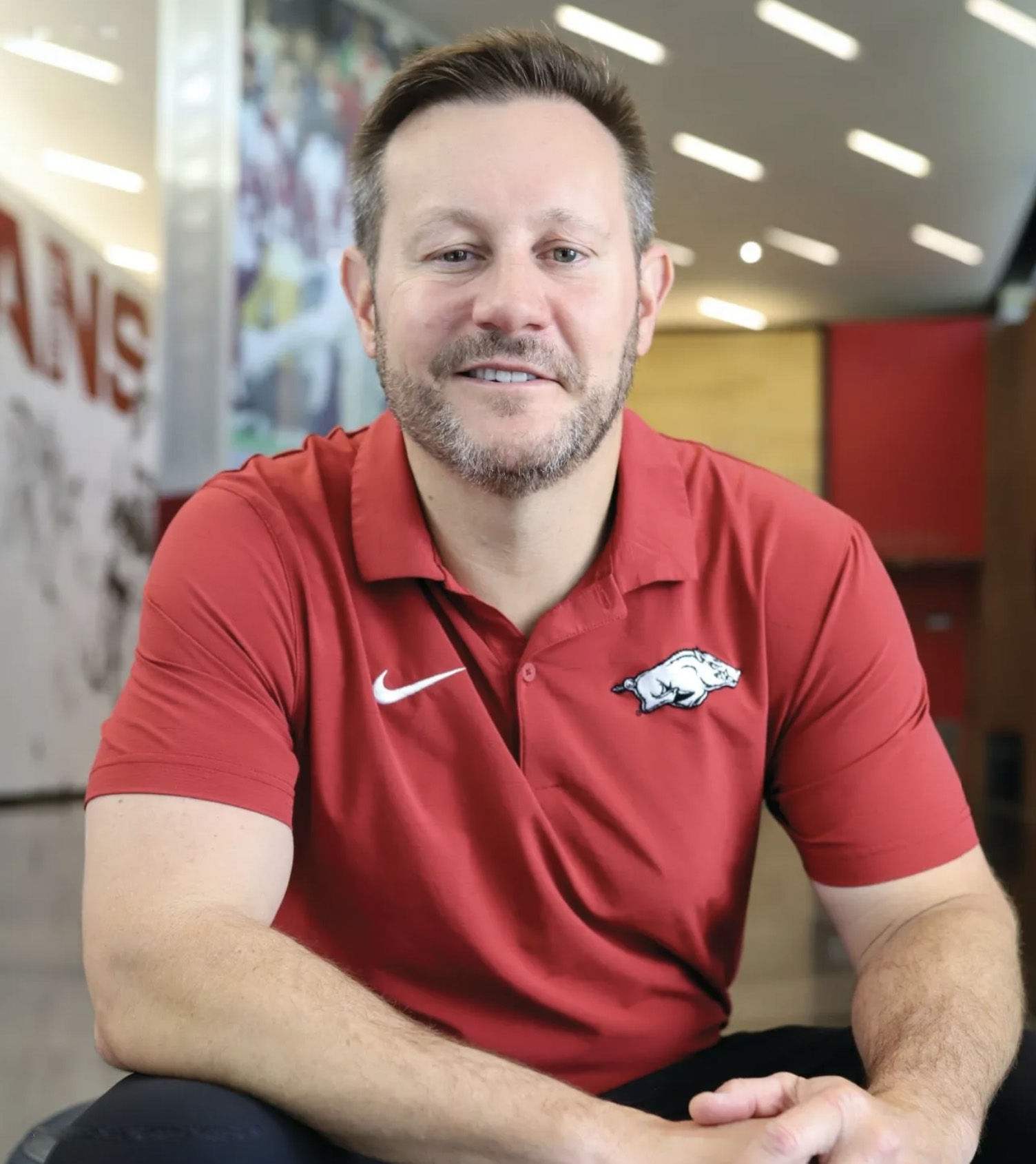
One of the first exercises his players complete has nothing to do with a playbook. Each athlete identifies four goals for the season: one academic, one football-related, one in the weight room, and one personal. The coaching staff learns and encourages those personal goals, too. One player wants to read his Bible every night. Another wants to call his grandmother four times each week. Some are fathers themselves. “It’s not just, ‘Come in here and watch film.’ There are conversations about life and getting to know these young men as individuals, and how do we help them,” Silverfield explains, because developing players starts with knowing who they are before asking who they can become on the gridiron.
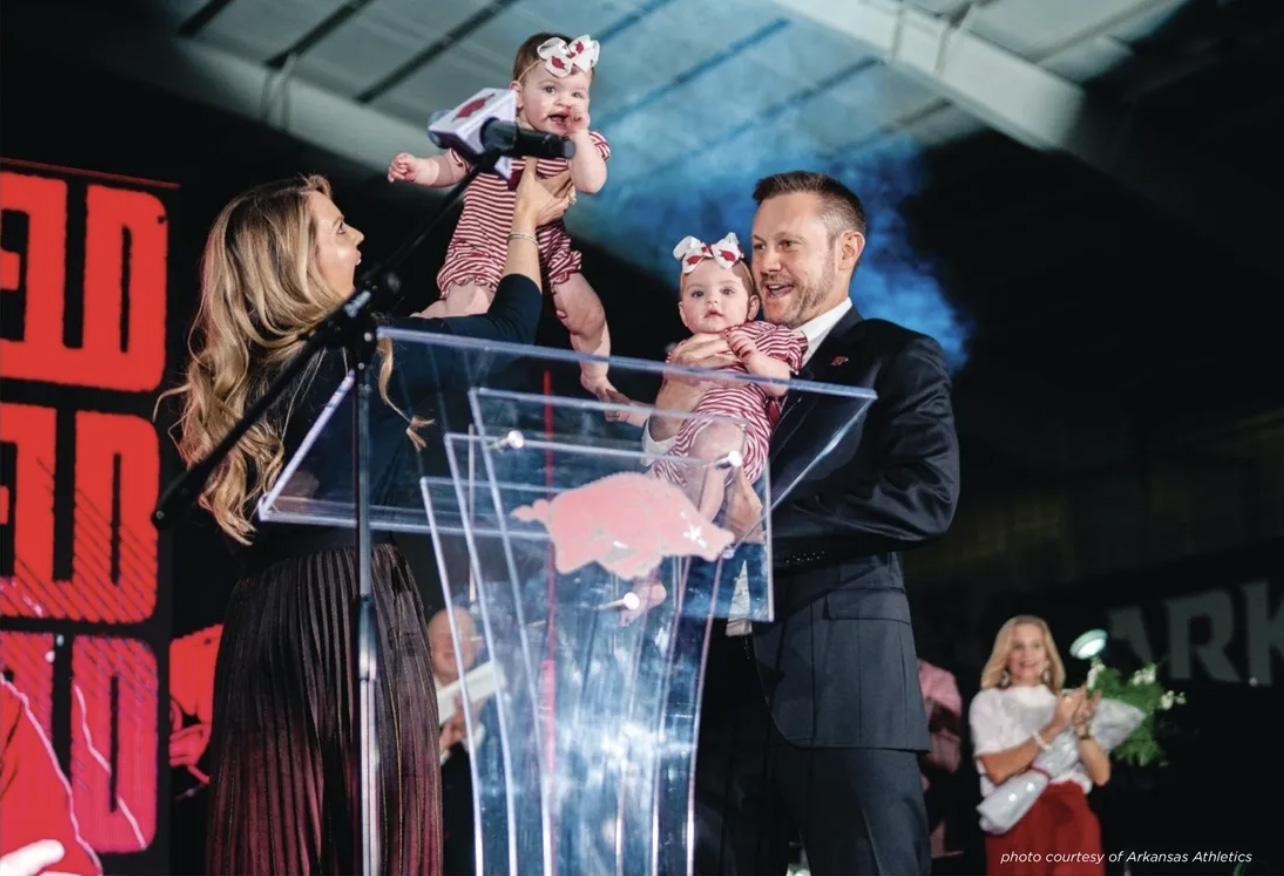
Working some 100 hours a week — “when all my meals are eaten at the same time that I’m changing clothes, watching film, taking notes, doing all those things,” he admits with a laugh — leaves little room in Silverfield’s schedule for anything outside football and family. With 15-month-old twin daughters at home, he and his wife, Katie, have become experts at stealing moments together. Sometimes that means running out to the office parking lot for three drive-by good-morning kisses at the beginning of another long day, or squeezing in recruiting calls after everyone else has gone to sleep. Years ago, he would often load his dogs into the back of the 4Runner while on the recruiting trail for Memphis. Though his girls are a bit small for that (the truck bed and the travel), he still looks for “every second, every opportunity we can” to keep his family as close as the job allows. “I’ve said forever that I raise 110 other people’s kids. I’d at least like to be somewhat present raising my own,” he quips.
Neither the work nor the scrutiny he’s under ever intimidated the Jacksonville, Florida native. Coming from Tennessee where fandoms are split across several pro, SEC, and other collegiate franchises, Arkansas’ expectations were part of the attraction. “This is a blue-collar state and kind of fits who I am — the kind of people who want to roll their sleeves up and go to work,” Silverfield insists. “I don’t want to go to a place where they don’t expect to win! No one’s going to have higher expectations for this program than myself.”
Months from now, fans will judge the Razorbacks by wins and losses. That’s the nature of college football. But Silverfield has already begun measuring the program against other metrics: in the chatter he’s hearing around the facilities, the standards players hold one another to, the details that communicate pride, and the shared responsibility he believes every successful program requires. He no longer feels compelled to have every answer himself. Instead, he measures leadership by whether the entire staff is equipped to help players become their best, both on and off the field. “I’m just fortunate enough to drive the bus,” Silverfield says. “My job is to be a good father, be a good husband, and then be the best damn football coach that I can be for the University of Arkansas, for this entire program, and for these young men, too.”
This digital version of the cover story is provided courtesy of Celebrate Arkansas Magazine for free online viewing. Enjoy our in-depth features and insights, brought to you digitally while preserving the quality and integrity of our print publication.
Like what you’ve read?
View a full digital copy of this issue for free now. Enjoy stories like this and so much more in each copy of Celebrate Arkansas.