
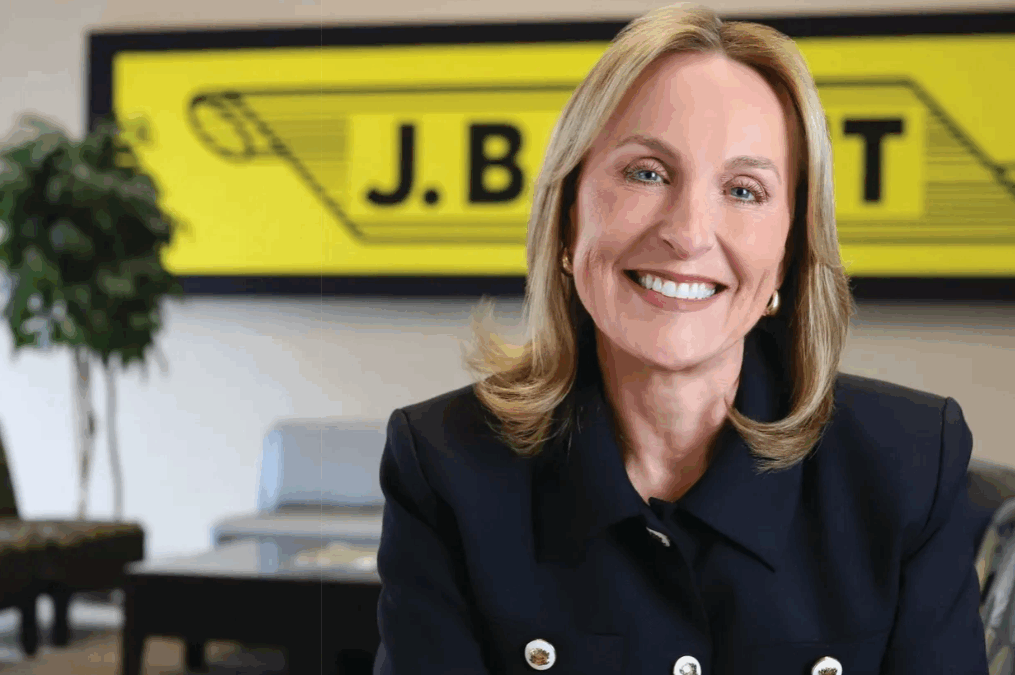
Shelley Simpson pauses mid-step, her gaze catching on a black-and-white photograph newly displayed in a remodeled hallway at J.B. Hunt’s headquarters. She’s never seen this particular image before. It captures the company’s late founder, J.B. Hunt himself, walking into the very building where she now stands — only decades earlier, during its construction.
Her expression shifts, momentarily captivated. There’s awe, delight, maybe even a touch of disbelief. Thirty years into her own journey with the company, there are still pieces of its history that find her, remind her of the weight of its legacy, and ignite the passion she carries forward as its newest CEO. That passion extends beyond preserving the past — it drives the company into the future with a reverence for the foundation on which it was built.
Two weeks after graduating from the University of Arkansas with a marketing degree, a 22-year-old Simpson started at J.B. Hunt Transport Services, Inc. as a customer service representative at $7.25 an hour. Over the next three decades, she took on a wide range of leadership and executive roles across the business before being named president in 2022. In July, she also became only the fifth CEO in the company’s 63-year history. It’s a familiar tune in Northwest Arkansas — a Fortune 500 company executive who started entry-level, worked through the ranks, and now sits at the helm of an organization deeply embedded in the region’s identity. But what distinguishes Simpson’s story is the path she took and the way she’s leading now, with a strong focus on people, culture, and the values that transformed her early role into a lifelong career. She understands that leadership requires more than strategy or metrics; it involves fostering an environment where employees feel valued and empowered to succeed.
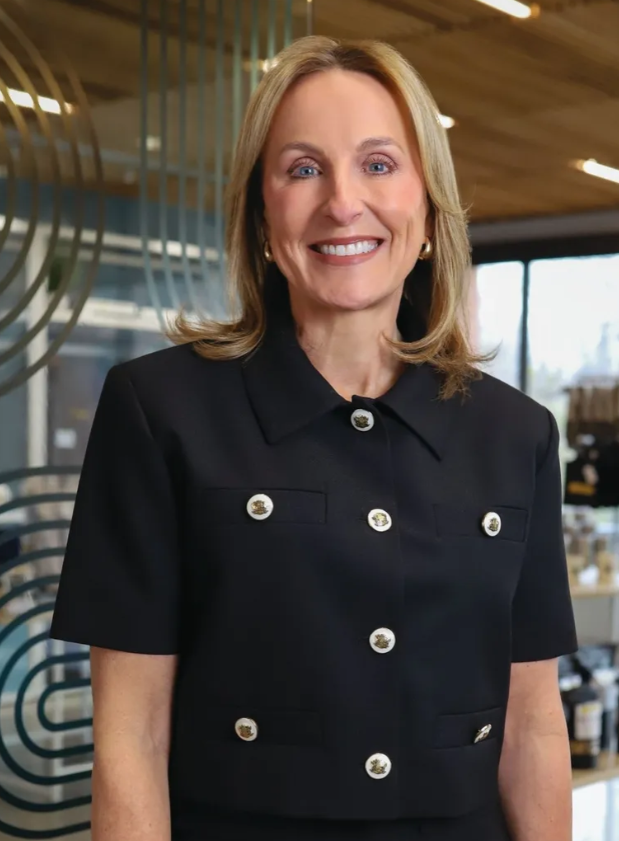
That culture of care is something Simpson is committed to strengthening — passing on what was modeled for her. “My very first day on the job, I sat beside a guy I work with to this day. He was an early mentor to me,” she shares. “My first sales guy, even though he retired about a year and a half ago, I still keep up with him. There were just some really great people along the way who wanted to mentor and pour into me.” These kinds of connections helped reframe J.B. Hunt in Simpson’s mind as somewhere she could build a career. But that realization was solidified with the arrival of a new family member.
After having her first child, Simpson recalls how she almost left J.B. Hunt. “I didn’t have confidence that I could do both really well,” she says of balancing motherhood and work. Her boss at the time — whom she describes as not just a mentor, but a sponsor — encouraged her and collaborated to make the situation doable for Simpson. Two years later when her twin girls were born and she needed more time with her family, the company again worked with Simpson on a plan to go part-time … as a newly appointed VP. “How I got treated through those two years showed me this place is different. That’s who the company’s been and who the company is today.”
When a frightening health condition saw her toddler life-flighted to Arkansas Children’s Hospital in Little Rock during this same season, Simpson remembers a moment that left a lasting impression: Keeping vigil at her son’s bedside, Shelley happened to be stretching her legs when, as she passed the hospital’s entrance, in walked two J.B. Hunt employees. “They didn’t work for me; I didn’t really know them well. They were headed to Memphis and knew that I was there with my son, and they came to pray with me.” If the conference table in her office were surrounded by her colleagues, each person could share a similarly meaningful story, she asserts.
Illustrating her point, Simpson is visibly touched sharing one driver’s story as yet another example of the company’s commitment to taking care of its people. When the woman’s son was undergoing cancer treatments in another state, her manager didn’t just approve the transfer — he arranged a warehouse job when she arrived so she could see her son every day. When his treatments ended, the driver was again supported in spending necessary time together until his passing. She was moved to share her story with Shelley as a compliment to that leader, but also in gratitude that she felt so supported by her employer. “When we go through hard times as a business, we come together,” Simpson says softly. “But we also have to understand that we have individuals here living their lives, and that’s what we’re really, really great at is humanizing our work. It isn’t 33,000 people; it’s 33,000 individual names.”

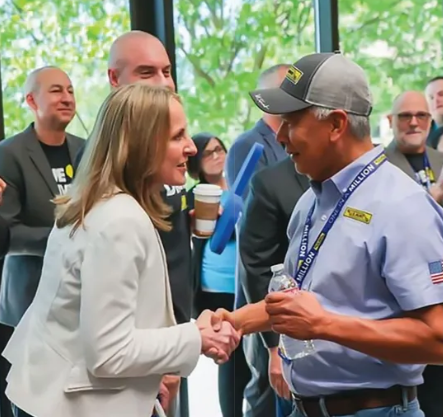
Spend just a few minutes with Simpson at the office and you’ll witness that philosophy in practice. During a recent visit, she frequently paused to greet employees — a light touch on an arm, a quick wave across the room, a warm exchange sparked by a passing joke. Her presence is natural and unforced, that accessibility reinforcing a message that leadership should be visible, present, and engaged. When she became president almost three years ago, Simpson met with every senior VP and above, asking them a few key questions, including, “How can I better support you?” A common theme she heard? Her time. So, she restructured her schedule, freeing up half the day to be more accessible. “I wish I had done that years ago,” she admits, noting how the ability to grab those quick conversations and check-ins has made her a better leader. “That is my role, to best support our team.”
Balancing the weight of legacy with a sharp focus on the future, innovation remains a cornerstone at J.B. Hunt where forward motion has defined the company’s history. From pioneering intermodal transportation to leading digital freight innovation, to seeing roughly 90% of drivers home at least on a weekly basis, evolution has been a constant. Simpson remembers assuming when she first started at the company that it must have already hit its ceiling as a billion-dollar organization. Today, it’s more than 13 times that size. Despite operating at the top of five major business units within a $600 billion market, Mr. Hunt would still be asking, “Well, is it big yet?” Simpson suggests with a grin. “I have that same measure, which I think our whole company does. Is $13 billion big yet to our potential? I don’t think so. If we continue to do the right thing — take care of our people, our customers, and our shareholders — growth is inevitable.”
The company has embraced new technologies that not only optimize operations but also improve the experience for drivers and customers. Simpson recalls how the mindset toward digital transformation has shifted over time. “We went from asking ‘how do we make this investment?’ to ‘this is just who we are,’” she says. Recent sustainability efforts include a new solar facility in Gentry, which offsets up to 80% of the power used by J.B. Hunt’s three main corporate buildings — enough energy to power nearly 1,200 homes each year and the equivalent of removing 1,400 passenger vehicles’ carbon emissions from the road. The company’s commitment to sustainability was further recognized with a place on the 2024 North American Dow Jones Sustainability Index, ranking it among the top 20% of the continent’s largest companies for long-term environmental and social progress.
Simpson often reflects on how the partnership between J.B. Hunt’s founders shaped the culture that persists today. “Mr. Hunt was the dreamer, the visionary, always pushing forward. Mrs. Hunt was about excellence, the details, the execution. That combination built something special,” she explains. It’s hard not to see parallels in Simpson’s own marriage to husband David, who was also at the company more than three decades. “What a great advantage I have that I live with a man who is in love with the company, too. I can come home and have a conversation around anything, and he fully supports and gets it because he also had a good career here.” That industry love continues with their children, too, as all three graduate from the U of A in May — the girls both going into supply chain and her son pursuing entrepreneurship. A Russellville native, Simpson has treasured having family close enough to attend Razorback basketball games together and keep a standing Sunday dinner and game night.
While no two days are the same for Simpson, she always starts with a 5 a.m. faith walk around her neighborhood, followed by a workout usually combining HIIT and weight training. By the time her workday begins, she’s already engaged mentally, spiritually, and physically. “I’m very purpose-driven,” she admits, “and live according to my life’s mission: To create an internal impact in leadership by serving people, loving others, and being a good witness while integrating my faith, family, work, and community. That’s my personal North Star, so every day I wake up, I can’t wait!”
Simpson carries her charge of stewardship with a sense of purpose, ensuring that what was built before her continues to thrive long after her tenure. As she passes that black-and-white photo, she isn’t just looking at history — she’s stepping into it, shaping what comes next with the same authenticity and dedication that have grown over the course of her career. In doing so, she ensures that the legacy of J.B. Hunt is not only preserved but propelled forward, strengthened by the people who make it all possible. Under her leadership, the company’s next chapter is already being written, one that honors the past while embracing the limitless potential of the future.
This digital version of the cover story is provided courtesy of Celebrate Arkansas Magazine for free online viewing. Enjoy our in-depth features and insights, brought to you digitally while preserving the quality and integrity of our print publication.
Like what you’ve read?
View a full digital copy of this issue for free now. Enjoy stories like this and so much more in each copy of Celebrate Arkansas.